What If Social Media Isn't Social at All? What If We're All Just Living in Our Own Little Timelines? 🚀

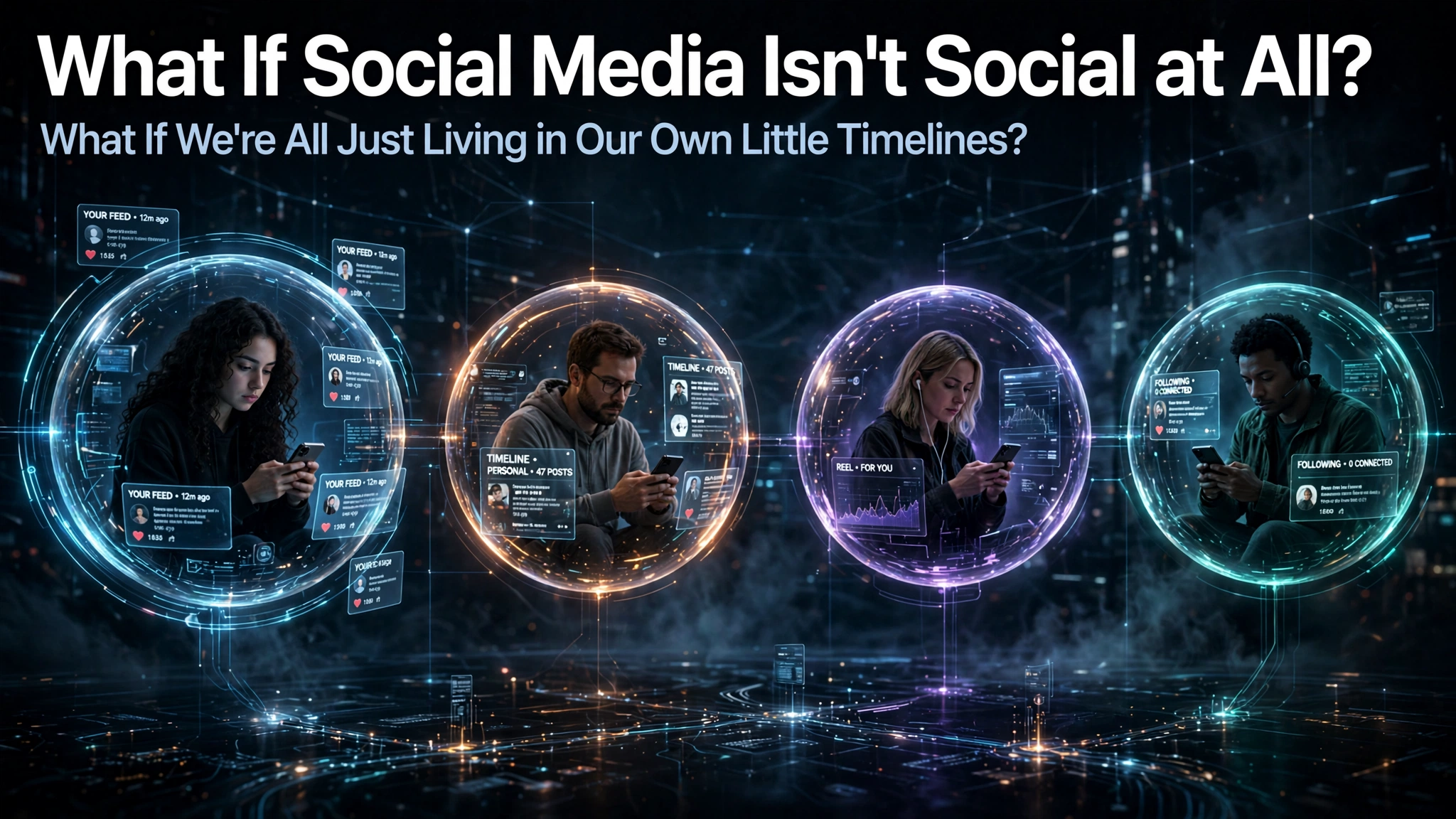
What if social media isn't actually social? What if we're all sitting in our own little spaceships, floating through the same digital universe, convinced we're connected because we occasionally see somebody else's spacecraft pass by? 😂
Think about it for a second. We call these platforms social networks. We talk about building communities, connecting with people, sharing experiences, and bringing the world closer together.
But what if that's not really what's happening?
What if everybody is living inside their own personalized timeline, surrounded by content specifically selected to keep them interested, entertained, distracted, and engaged?
You're scrolling through your feed, seeing the people you follow, the subjects you interact with, the opinions you agree with, and the content an algorithm believes you'll spend time watching.
Meanwhile, somebody else opens the exact same platform and sees an entirely different digital universe.
You're technically on the same social network, but you're not necessarily experiencing the same network.
WE'RE ALL IN THE SAME UNIVERSE, BUT WE'RE NOT LOOKING THROUGH THE SAME WINDOWS.
Imagine every user as a spaceship traveling through outer space. Each spaceship has its own navigation system, its own destination, its own collection of passengers, and its own view of the universe.
Every now and then, two spaceships cross paths. Somebody comments on your post. You discover another creator. A conversation happens. Maybe you even develop a genuine connection.
But once that interaction ends, everybody returns to their own timeline.
You're not necessarily sharing an experience. You're briefly intersecting with somebody else's digital environment.
And the algorithm acts like the navigation system, deciding which signals you receive, which destinations appear on your radar, and which other spaceships you're likely to encounter.
THE ALGORITHM ISN'T JUST SHOWING YOU CONTENT. IT'S SHAPING YOUR EXPERIENCE OF THE WORLD.
Social platforms use recommendation systems, engagement signals, followed accounts, viewing history, and other factors to personalize what appears in your feed. That means two people can open the same application and receive dramatically different versions of what appears to be the same public conversation.
One person might believe everybody is talking about politics. Another thinks the entire world is discussing entertainment. Somebody else sees nothing but business opportunities, motivational content, relationship advice, and people showing off their latest purchases.
And all three might walk away believing they're looking at what's happening in the world.
But they're looking at different selections of it.
That's a problem when we start confusing our personal feed with reality.
Just because something appears everywhere in your timeline doesn't mean it's everywhere in society. It might simply be everywhere in your particular digital neighborhood.
WE'RE DEVELOPING DIFFERENT VERSIONS OF REALITY.
Think about how two people can have completely opposite opinions about the state of the world while both believe the evidence is right in front of them.
One sees stories about economic opportunity. Another sees stories about economic collapse. One sees people celebrating relationships. Another sees people complaining about dating. One sees political victories. Another sees political disasters.
Neither person necessarily has the complete picture.
Their timelines are giving them different samples of the same world.
And when those people finally interact, they sometimes argue as if the other person is deliberately ignoring reality.
Maybe they're not ignoring the same reality. Maybe they've been navigating entirely different information environments.
THE SOCIAL PART MIGHT BE THE SMALLEST PART OF SOCIAL MEDIA.
We have more ways to communicate than ever before, but communication isn't automatically connection.
A like isn't a friendship. A follower isn't a community member. A view isn't a conversation. And having thousands of people in your audience doesn't mean thousands of people actually know you.
You can spend hours interacting with people online and still feel like you're operating alone.
That's because many platforms are designed around individual feeds and individual engagement patterns. The experience can feel communal, but the distribution is often personalized.
We're all watching the same digital sky, but the platform decides which stars we're allowed to notice.
AND HERE'S WHERE IT GETS INTERESTING FOR CREATORS.
If everybody has their own timeline, then building an audience isn't necessarily about getting your content in front of everybody. It's about finding the people whose digital environments overlap with what you're creating.
That's why a creator can have a massive following and still struggle to reach those followers. The audience exists, but access to that audience is mediated by the platform's distribution system.
You're not necessarily publishing to a community that automatically receives your updates. You're submitting content into an ecosystem where the platform decides how much visibility it receives.
And that's why owning your own website, mailing list, or independent community matters. You need somewhere people can find you that isn't entirely dependent on somebody else's algorithm.
Social platforms can be the spacecraft that introduces people to your work. Your own digital property can be the destination where they actually establish a lasting connection.
MAYBE WE DON'T NEED MORE SOCIAL MEDIA. MAYBE WE NEED MORE ACTUAL SOCIAL INTERACTION.
Imagine if we spent less time trying to optimize our timelines and more time intentionally connecting with people outside our personalized bubbles.
Imagine following people because their perspectives challenge yours instead of because they constantly reinforce what you already believe. Imagine discovering communities instead of waiting for an algorithm to introduce you to them.
Imagine realizing that the world is much bigger than the collection of posts appearing on your screen.
THE BOTTOM LINE:
Maybe social media isn't one giant digital gathering place. Maybe it's millions of personalized environments connected by occasional interactions, all operating under the illusion that we're experiencing the same thing.
We're all traveling through the same digital universe, but each of us has a different map, a different destination, and a different view outside the window.
Sometimes our spaceships cross paths. Sometimes we communicate. Sometimes we collide over an opinion neither of us would have encountered without an algorithm putting us in the same orbit.
But the real question is whether we're actually building connections or simply passing one another in an endless digital atmosphere.
Because if everybody is living inside their own timeline, maybe the biggest illusion of social media isn't that we're connected.
It's that we're all experiencing the same world just because we're using the same application. 🚀





Comments
No comments yet, be the first submit yours below.