The Anunnaki and the Sumerians: What If the Oldest Civilization on Record Was Telling Us Something We Still Don't Understand?

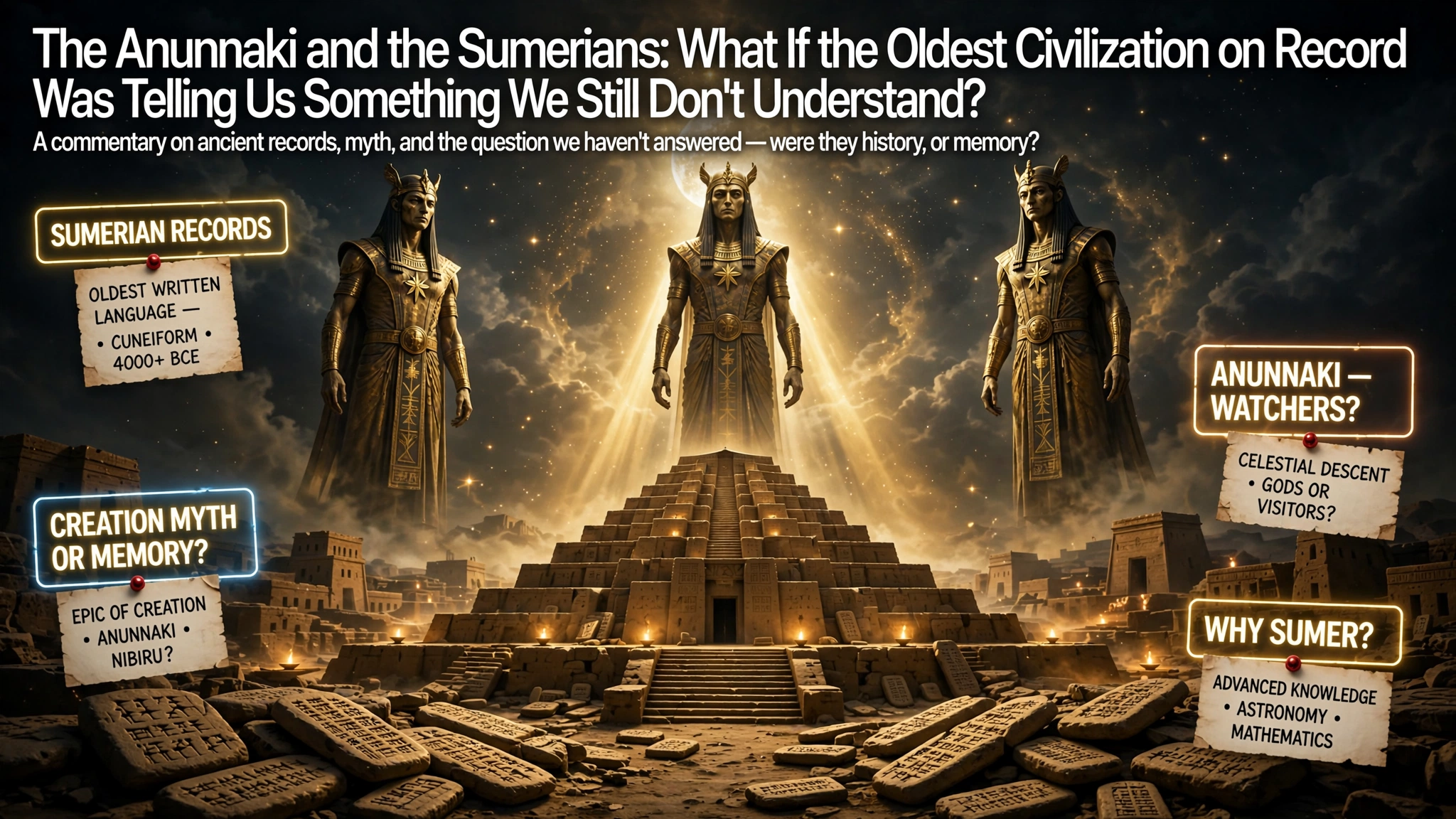
Thousands of years before modern science, smartphones, space exploration, and artificial intelligence, the Sumerians were already building cities, tracking the stars, developing mathematics, and writing stories about powerful beings who came down from the heavens. And buried inside their mythology is a name that has fueled one of the most fascinating debates in alternative history: the Anunnaki. Were they simply ancient gods, or is there something about these stories that people are interpreting differently?
Let's go back approximately 5,000 years to ancient Mesopotamia, the region between the Tigris and Euphrates rivers, largely located in modern-day Iraq.
This is where the Sumerian civilization developed. The Sumerians built some of the earliest known cities, established complex systems of government, developed cuneiform writing, and made significant contributions to mathematics, astronomy, agriculture, and architecture.
These weren't people who had just figured out how to stack rocks. They were organizing cities, managing resources, documenting transactions, and observing the heavens long before the modern world existed.
And their religious traditions included an intriguing group of divine beings known as the Anunnaki.
WHO WERE THE ANUNNAKI?
In ancient Mesopotamian religion, the Anunnaki were a group of gods associated with the divine order, kingship, creation, and the fate of humanity. Their roles and descriptions changed across different periods and texts.
Some important figures in Mesopotamian mythology included:
- Anu: A major sky god associated with authority among the gods.
- Enlil: A powerful deity associated with wind, air, authority, and divine decisions.
- Enki (Ea): A god associated with wisdom, freshwater, crafts, and creation, often portrayed as helping humanity.
- Inanna (Ishtar): A prominent goddess associated with love, fertility, war, and political power.
- Ninhursag: A mother goddess associated with fertility, creation, and the earth.
These figures appear in different combinations throughout Mesopotamian religious traditions. The Anunnaki weren't necessarily one fixed group with an identical role in every ancient text.
But here's where modern interpretations start getting interesting.
WHAT IF THE GODS WERE ACTUALLY VISITORS FROM ANOTHER WORLD?
Modern ancient-astronaut theories propose that descriptions of gods descending from the heavens could represent encounters with extraterrestrial beings rather than supernatural entities.
According to some versions of this theory, the Anunnaki were an advanced civilization that traveled to Earth from another planet. Some interpretations claim they came here searching for natural resources, particularly gold, and eventually influenced or engineered humanity.
One popular version claims that the Anunnaki genetically modified early humans to create a workforce capable of mining resources for them.
Now, that's a fascinating science-fiction premise. But is it actually what the Sumerians wrote?
THE NIBIRU CONNECTION
You've probably heard the name Nibiru connected to the Anunnaki.
In modern ancient-astronaut literature, Nibiru is often described as a mysterious planet with an enormous orbit that periodically brings its inhabitants near Earth.
The idea became especially popular through the writings of Zecharia Sitchin, who argued that ancient Mesopotamian texts contained evidence of an extraterrestrial civilization.
However, mainstream scholars do not accept those translations. In Mesopotamian astronomy and mythology, Nibiru has different meanings depending on the text and context, including an astronomical designation associated with a celestial body or crossing point. There is no established evidence that it was the home planet of an alien civilization.
And despite the popularity of the theory, astronomers have not confirmed the existence of a hidden planet on the proposed orbit that periodically approaches Earth.
Still, it's interesting how a single ancient name can inspire an entire modern mythology.
THE MYSTERY OF HUMAN CREATION
One of the most interesting parts of Sumerian and broader Mesopotamian mythology is that humanity's creation is already part of the ancient stories.
In the Babylonian creation epic known as the Enuma Elish, humans are created from the blood of a defeated divine figure, Kingu, to serve the gods. In the Atrahasis Epic, humanity is created from clay mixed with the flesh and blood of a slain god to take over labor previously performed by lesser gods.
These are religious creation narratives, not scientific accounts of genetic engineering.
But modern alternative-history theories interpret these stories differently. They ask whether descriptions of divine beings combining materials, creating life, or shaping humanity could be misunderstood accounts of advanced biological technology.
It's an interesting question to explore, but there is no archaeological or genetic evidence establishing that extraterrestrials engineered humanity.
WHY WERE THE SUMERIANS SO ADVANCED?
Here's something that doesn't require an extraterrestrial explanation to be impressive.
The Sumerians developed one of the earliest known writing systems. They built monumental structures, organized complex economies, developed mathematical systems based on 60, and maintained records of astronomical observations.
Our modern system of measuring time still carries a piece of that mathematical legacy. Sixty seconds in a minute. Sixty minutes in an hour. Three hundred and sixty degrees in a circle.
They also developed sophisticated irrigation systems and managed agricultural production across an environment where controlling water was essential to survival.
So when somebody asks how an ancient civilization accomplished so much, the answer doesn't have to be aliens. Human intelligence, accumulated knowledge, experimentation, trade, and generations of innovation can produce extraordinary achievements.
And frankly, giving ancient humans credit for their accomplishments is just as interesting as imagining extraterrestrial assistance.
WHY DO THESE STORIES STILL CAPTIVATE US?
Maybe it's because humanity has always looked toward the sky and wondered whether something else was out there.
Ancient civilizations created elaborate stories about gods descending from the heavens. Modern civilization creates stories about extraterrestrials arriving in spacecraft. The imagery changes, but the fundamental question remains: Are we alone?
There's also something fascinating about the survival of ancient records. We can still examine clay tablets written thousands of years ago and read accounts of how people understood their world, their gods, their rulers, and their place in the universe.
Those records deserve serious study. They shouldn't be dismissed simply because they're ancient, but they also shouldn't be rewritten to support claims the original evidence doesn't establish.
THE BIGGER QUESTION
What if the most fascinating part of the Anunnaki story isn't whether they were aliens, but how much humanity was already capable of accomplishing thousands of years ago?
We have ancient texts describing divine beings, creation, floods, kings, celestial observations, and the relationship between humanity and the heavens. We have archaeological evidence of cities, temples, writing, and mathematical systems that helped shape later civilizations.
We should absolutely keep asking questions about our origins. We should examine ancient texts, challenge questionable interpretations, and remain open to discoveries. But there's a difference between investigating history and treating speculation as established fact.
Perhaps the Sumerians were describing gods through the worldview of their time. Perhaps future discoveries will reveal details about ancient life that we haven't considered. And perhaps one day humanity will find undeniable evidence of extraterrestrial intelligence.
But until then, the Anunnaki remain part of a remarkable ancient religious tradition surrounded by modern theories that are far more speculative than the surviving evidence.
Five thousand years ago, people were already looking at the stars and asking questions about where we came from. We're still doing it today. Apparently, humanity has been trying to figure out its origin story since before anybody had a smartphone to argue about it on.









Comments
No comments yet, be the first submit yours below.