You Don't Actually Own Your Digital Life—You're Just Renting Access to Someone Else's Computer

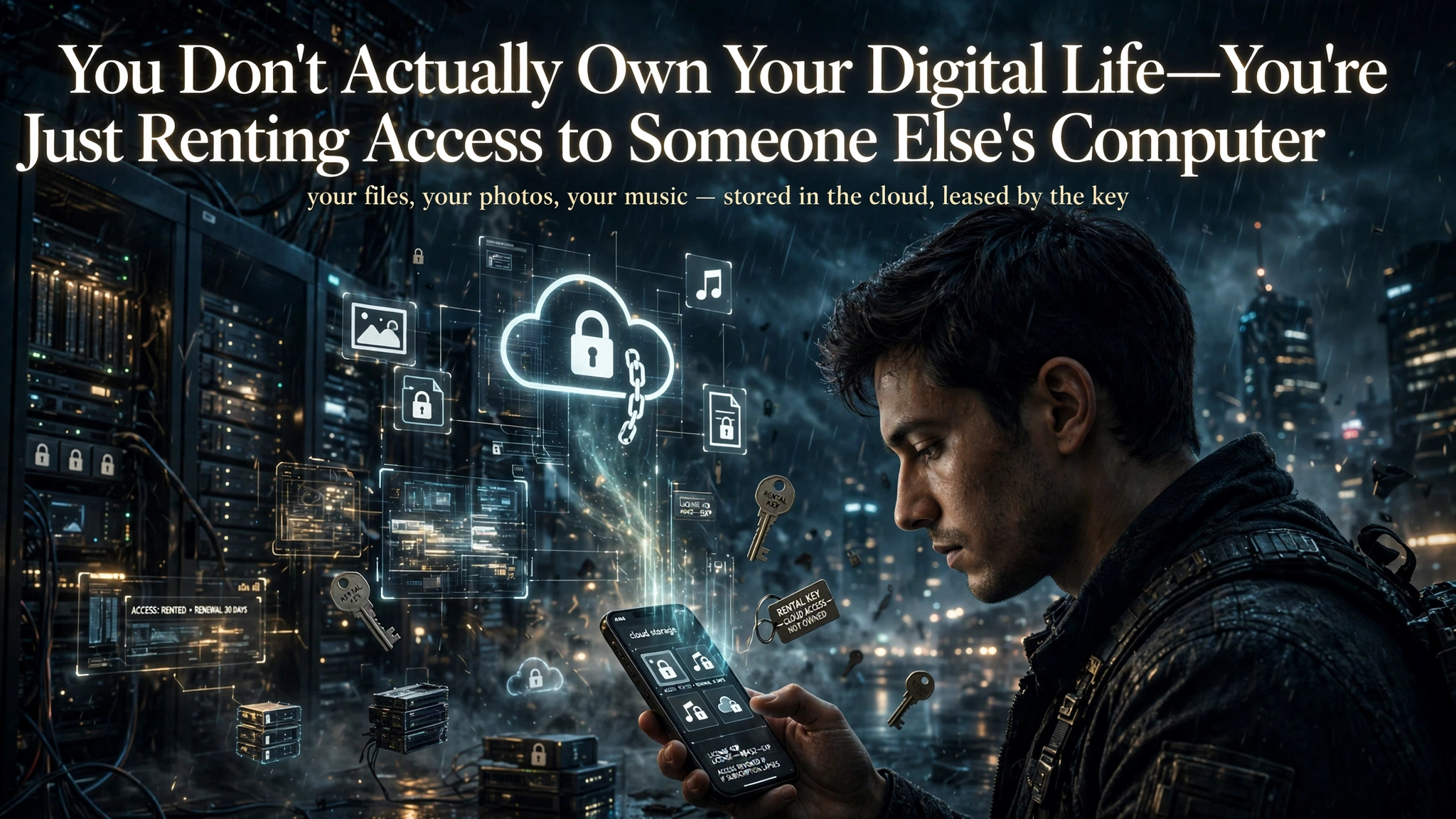
You bought the phone. You paid for the internet. You created the account. You uploaded the pictures, built the audience, published the content, and spent years creating a digital identity. But one morning, a company can suspend your account, change its policies, remove your content, or shut down a service—and suddenly, your entire digital life is sitting behind a login screen you no longer control. Congratulations. You've built an empire on somebody else's property.
We talk about ownership like it's something obvious. If you buy a house, it's yours. If you buy a car, it's yours. If you purchase a computer, you expect to control what happens on it.
But the digital world operates under a different set of rules.
You might spend ten years building a social media following, only to discover that your account can be restricted without warning. You might upload thousands of photographs to a cloud service, assuming they're safely stored, until your subscription expires or the provider changes its terms. You might purchase a movie digitally and later discover that what you actually purchased was a license to access it under certain conditions.
And somehow, we've normalized this arrangement.
YOU DON'T OWN YOUR FOLLOWERS.
Imagine spending years building an audience of 50,000 people. You create content, respond to comments, establish relationships, and develop a recognizable brand.
Then the platform changes its algorithm.
Suddenly, your reach disappears. Your posts aren't being distributed like they used to be. Your followers haven't necessarily left, but you can't reliably reach them anymore.
Worse, if your account gets suspended, your ability to communicate with that audience can disappear almost overnight.
That's the uncomfortable reality of building a business entirely on rented digital land.
You may have created the audience, but the platform controls the infrastructure connecting you to it.
That's why an independent website, an email list, and direct relationships with your customers matter. Social platforms can help you attract attention, but they shouldn't be the only place your business exists.
YOU DON'T ALWAYS OWN WHAT YOU PURCHASE.
Remember when buying a movie meant bringing home a physical disc? You could put it on a shelf, lend it to somebody, and watch it without checking whether a company still wanted to provide access.
Digital purchases have changed that relationship.
Many digital storefronts sell licenses rather than unrestricted ownership. The terms vary by service and product, but access can depend on licensing agreements, account status, regional availability, and platform policies.
Music, movies, games, books, and software can all be affected.
You might have spent hundreds of dollars building a digital library, but you may not have the same rights you would have if you owned physical copies.
You're not necessarily buying the product in the traditional sense. Sometimes you're buying permission to use it.
That's a pretty important distinction when the receipt says PURCHASED.
YOUR CLOUD IS SOMEBODY ELSE'S HARD DRIVE.
Cloud storage is convenient. You can access your files from multiple devices, share documents, and avoid carrying physical storage everywhere.
But let's be clear about what the cloud actually is: someone else's infrastructure, operated by a company that controls the service.
Your files might be stored in professional data centers, replicated across systems, and protected by sophisticated security measures. That doesn't mean you have unlimited control over them.
Subscriptions can become more expensive. Storage limits can change. Accounts can be locked. Services can be discontinued.
And if you don't maintain independent backups, you may discover that convenience came with a dependency you never considered.
A cloud backup is useful. Multiple copies under your control are better.
THE INTERNET WAS SUPPOSED TO CONNECT US. NOW WE DEPEND ON GATEKEEPERS.
Think about how much of everyday life runs through a handful of companies.
Your communication, entertainment, payments, business operations, navigation, photographs, documents, and professional identity may all depend on services operated by organizations you don't control.
That doesn't automatically make those companies evil. Building and maintaining infrastructure costs money. Platforms need policies, security systems, and operational standards.
But concentration creates dependency.
When a service becomes essential, the company operating it gains considerable influence over the people and businesses relying on it.
And if the service changes, everybody downstream has to adjust.
THE DIFFERENCE BETWEEN HAVING AN ACCOUNT AND HAVING CONTROL.
Having a login doesn't mean you own the platform. Having followers doesn't mean you own the distribution. Having a digital purchase doesn't necessarily mean you own an unrestricted copy. Having files in the cloud doesn't mean you control the infrastructure storing them.
These distinctions matter because digital convenience can make dependency almost invisible.
So what can you actually do?
- Own your domain: Build an independent website that isn't dependent on a social platform for its existence.
- Maintain your own backups: Keep important photographs, documents, databases, and creative work in storage you control.
- Export your data: Regularly download information from services that provide export options.
- Build direct communication channels: Maintain an email list or other legitimate ways to reach your audience outside social media.
- Understand digital licenses: Know whether you're purchasing a product, a subscription, or limited access.
- Reduce unnecessary dependencies: Don't put every important part of your personal or professional life inside one company's ecosystem.
THE BIGGER QUESTION
What happens when an entire generation grows up believing that access is the same thing as ownership?
We already have people who don't own physical music collections, don't maintain local copies of their photographs, don't control their websites, and conduct entire businesses through platforms they cannot influence.
Everything works beautifully until something changes.
And when it does, the person who created the content, built the audience, or purchased the digital product may have surprisingly little control over what happens next.
Technology was supposed to give ordinary people more independence. In many ways, it has. But we've also traded some forms of ownership for convenience, subscriptions, and access agreements.
Don't misunderstand me. Use the platforms. Enjoy the convenience. Take advantage of the technology.
Just don't confuse being allowed to use something with actually owning it.
Because the most expensive thing you can lose in the digital economy might not be your money. It might be the years you spent building something you never truly controlled.






Comments
No comments yet, be the first submit yours below.