If Your Child Is Under 18, Think Twice Before Buying Them GTA 6—You're Teaching Them to Treat Robbery and Violence Like a Game

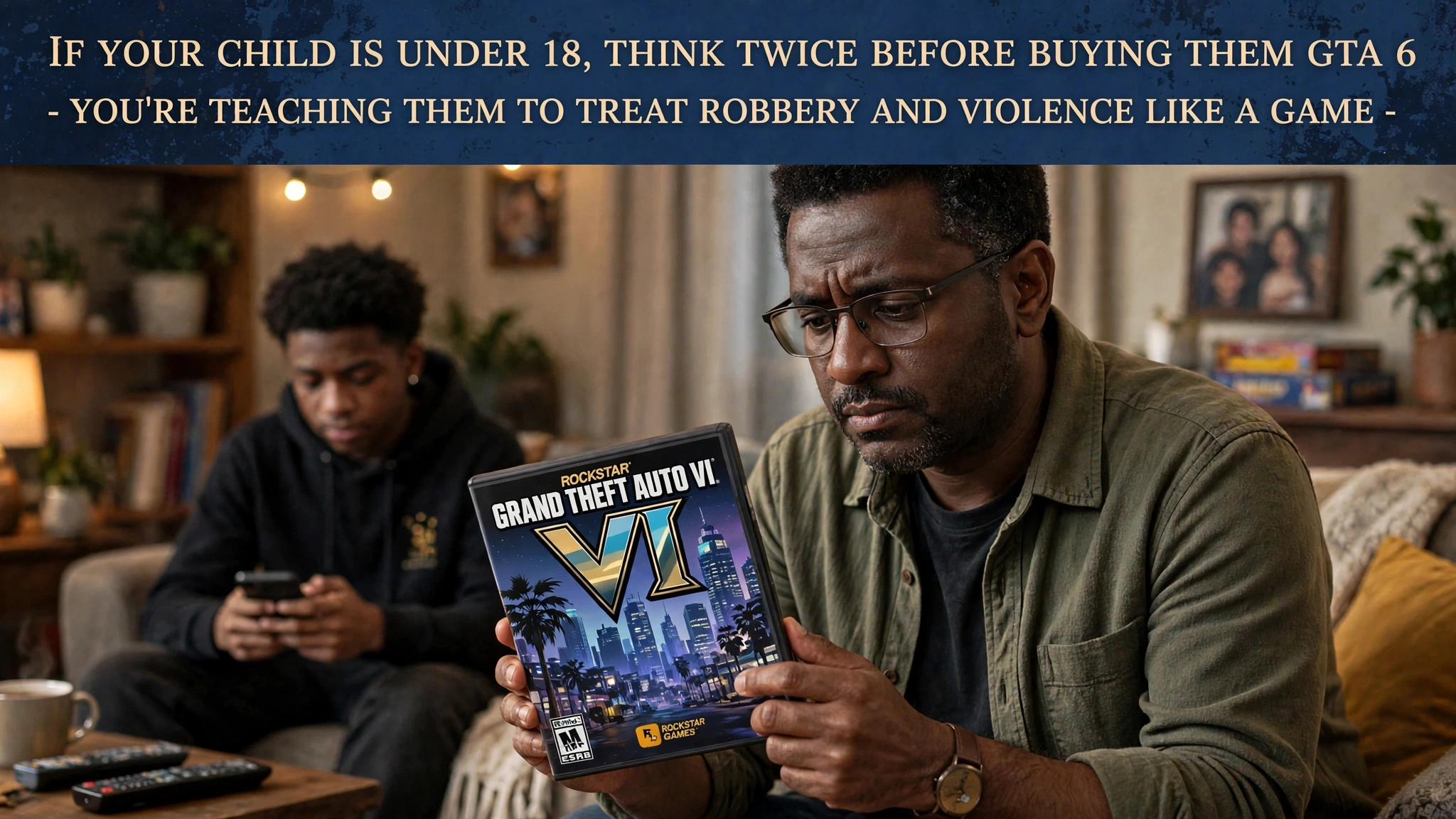
Parents will tell their children not to steal, not to hurt people, not to carry weapons, and not to get involved in criminal activity. Then they'll turn around and buy them a video game where they spend hours robbing people, shooting characters, stealing cars, and building a criminal empire. At what point do we stop pretending the environment we're creating doesn't matter?
Let's have a conversation about Grand Theft Auto 6 and parenting.
If your child is under 18, I believe you should think twice before buying them this game. And I'm not talking about simply putting a restriction on what they can watch. I'm talking about what happens when children are actively participating in simulated criminal behavior for entertainment.
There's a difference between watching a character commit a robbery in a movie and sitting in front of a screen controlling that character while they do it.
In GTA, you're not just observing the criminal lifestyle. You're participating in it through gameplay. You're stealing vehicles, robbing businesses, using weapons, fighting, escaping police, and completing missions that can reward criminal activity with money and progression.
And that's the conversation parents need to have.
Children Learn From the Environment Around Them
Children are constantly learning, even when we don't realize it. They observe how adults behave, how people communicate, how conflicts are handled, and what kinds of actions receive attention or rewards.
They learn through repetition, observation, and experience. That's why parents spend so much time trying to create positive environments for their children.
We tell them to respect people, keep their hands to themselves, work honestly for what they want, and understand that actions have consequences.
But then we introduce entertainment that repeatedly places them inside environments where those same behaviors are turned into objectives.
Robbery becomes a mission. Stealing becomes a way to make money. Violence becomes a method of getting what you want. Running from the police becomes an exciting challenge.
It's fictional, but the behaviors being represented are recognizable real-world actions.
That doesn't mean every child who plays GTA will grow up to commit crimes. It does mean parents should think critically about the messages their children repeatedly consume and how prepared they are to distinguish fantasy from reality.
You're Not Just Watching Violence. You're Controlling It.
This is what makes interactive entertainment a different conversation from simply watching a violent scene on television.
When a child watches a movie, they're observing a character. When they play a game like GTA, they're making decisions through that character.
They decide when to pull the trigger. They decide when to steal a vehicle. They decide how to approach a criminal mission. They learn the mechanics of completing those objectives.
The game turns those actions into something to accomplish.
Think about the difference between hearing that robbery is wrong and spending an evening completing simulated robberies because the game tells you that's how you advance.
In the real world, a robbery isn't an exciting mission. It's a crime against another human being. Somebody can lose their money, their sense of safety, or even their life.
But inside a game, you can restart, reload, and try again.
Real victims don't respawn. Real consequences don't disappear when you turn off the console.
That's a distinction children need to understand, and parents shouldn't assume every child is mature enough to process it without guidance.
When Criminal Behavior Becomes Entertainment
Let's look at the bigger picture of what GTA represents.
The franchise has built much of its identity around criminal lifestyles, organized crime, weapons, theft, violence, and making money through illegal activities.
Players can experience a fictional world where criminal behavior is often connected to excitement, status, rewards, and progression.
Imagine a child repeatedly seeing characters gain money and recognition through robbery, intimidation, and violence. Even if they understand that the game isn't real, parents should still consider what happens when those behaviors become familiar forms of entertainment.
We're living in a world where parents are already concerned about bullying, fighting, peer pressure, online behavior, and children being exposed to things before they're emotionally prepared.
Why would we ignore the content we're voluntarily bringing into the home?
Entertainment doesn't have to be educational to influence what children find interesting, funny, exciting, or acceptable. That's why conversations about media exposure matter.
You're Teaching Them What a Hustle Looks Like
Another part of this conversation is the way games can present money and success.
GTA frequently connects progression and financial rewards to criminal activity. You complete missions, participate in illegal operations, steal, fight, and move through a world where criminal opportunities are part of the gameplay.
Now compare that with what we're trying to teach children outside the game.
We tell them to go to school, develop skills, get an education, find employment, start businesses, save money, and build something legitimate.
We want them to understand that success takes discipline, patience, and responsibility.
But inside the game, the fictional shortcut to money can involve robbing somebody, stealing something, or participating in criminal activity.
Again, playing a game doesn't automatically determine a child's values. But parents should recognize the contradiction between the lessons they're teaching at home and the fictional world their children are spending hours navigating.
We shouldn't have to wait until a child starts imitating something before we decide the content deserves our attention.
The Age Rating Isn't Just Decoration
Grand Theft Auto VI carries an ESRB Mature 17+ rating. That means the game is intended for mature audiences, not young children.
And let's be clear: Mature 17+ does not mean a child must be 18 to play. But it does communicate that the content is designed for an older audience and that parents should take the rating seriously.
We already understand this with movies. A parent doesn't automatically buy a child every R-rated movie just because the child asks for it.
Why should video games be treated differently?
Because children are holding a controller instead of sitting in a movie theater, does that suddenly make the content harmless?
Parents have access to age ratings, content descriptions, parental controls, and gameplay footage. Take a few minutes to understand what you're purchasing before handing it to your child.
"Everybody Else Has It" Is Not an Excuse
This is where parents sometimes lose the argument before it even starts.
Your child says everybody at school is getting GTA 6. Their friends are talking about it. They're watching gameplay videos. They're telling you they're the only one who doesn't have it.
And now you're under pressure to buy something you might not even believe is appropriate.
But parenting isn't a competition between households.
Your responsibility isn't to make sure your child has everything their friends have. It's to make decisions that support their development, even when those decisions aren't popular.
Sometimes being a parent means saying no. Sometimes it means explaining why. And sometimes it means allowing your child to be disappointed because their happiness in that particular moment isn't more important than your judgment.
There are thousands of other games available. Your child isn't going to miss out on having a childhood because you decided one particular game isn't appropriate for them.
Don't Confuse Gaming Skills With Emotional Maturity
A child can understand how to operate a gaming console, complete complicated missions, and navigate an open-world environment without being emotionally prepared for every theme presented inside it.
Knowing how to play a game doesn't mean understanding the real-world implications of everything represented in that game.
Children are still developing their ability to evaluate consequences, understand perspectives, manage impulses, and distinguish entertainment from acceptable real-world behavior.
That's why parental involvement matters.
Don't assume that because your child says, "I know it's not real," the conversation is over. Ask what they're playing, what they enjoy about it, and whether they understand the difference between fictional rewards and real-life consequences.
Parents Should Be Paying Attention to More Than Screen Time
We talk about how many hours children spend on their phones, tablets, and gaming consoles. But maybe we should spend more time discussing what they're actually doing during those hours.
Two children can spend the same amount of time gaming and experience completely different content.
One might be building cities, solving puzzles, exploring fictional worlds, or learning creative skills. Another might be spending hours immersed in adult criminal themes.
The amount of screen time matters, but the content matters too.
Parents should know what their children are playing, who they're interacting with online, whether voice chat is enabled, and whether the content is appropriate for their age and maturity.
Don't hand over a controller and assume your parenting responsibilities are paused until the game is over.
The Bottom Line: You Have a Responsibility to Shape Their Environment
I'm not saying a child who plays GTA will automatically become violent or grow up believing robbery is acceptable. That would be an exaggeration, and it wouldn't be fair to the facts.
But I am saying that children learn from what surrounds them, and interactive entertainment deserves the same consideration we give other influences in their lives.
When a game turns stealing into a mission, violence into a mechanic, and criminal activity into a path toward rewards, parents should think about whether that is the kind of environment they want their children repeatedly participating in.
We spend years teaching children that hurting people is serious, stealing is wrong, and actions have consequences.
Let's not undermine those lessons by treating every form of entertainment as harmless simply because it's fictional.
If your child is under 18, you don't have to buy GTA 6. You don't have to follow the crowd. You don't have to justify your parenting decisions to other parents.
Your child doesn't need access to every adult experience just because technology makes it available.
Let children enjoy being children. Give them entertainment that fits their age. Teach them the difference between fantasy and reality. And when they're old enough to make their own decisions, they'll have a better foundation for understanding the world outside that screen.
Because in a video game, robbery might be a mission, violence might earn a reward, and criminal behavior might be entertaining. In real life, somebody has to live with the consequences.
Make sure your child understands the difference before you hand them the controller.







Comments
No comments yet, be the first submit yours below.