Workday Goes Down and Suddenly Employees Can't Access Their Workplace Accounts—How Much of Your Job Depends on Someone Else's Servers?

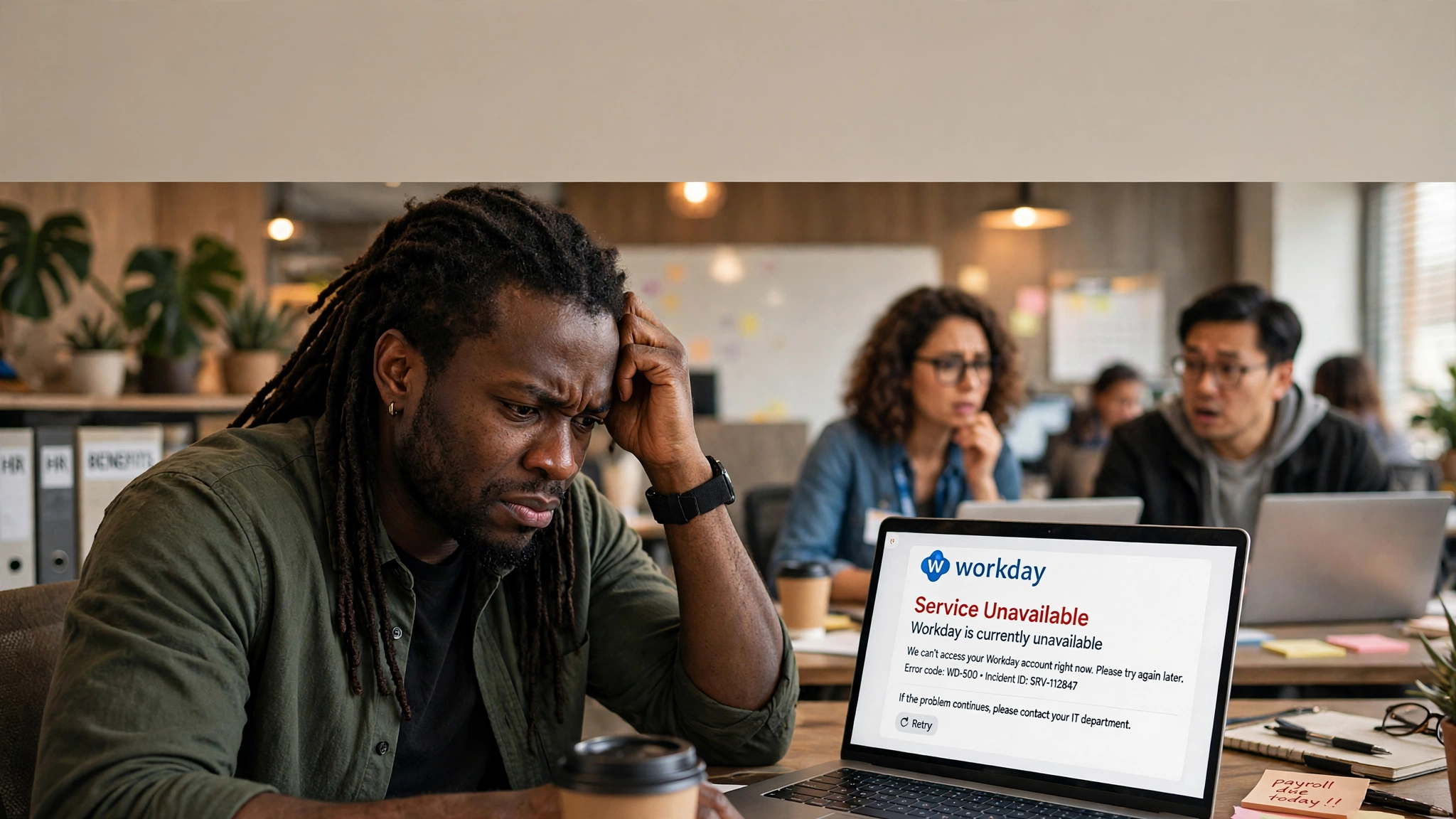
Imagine showing up for work, trying to check your pay, submit your hours, request time off, or access your employee benefits, only to discover that the platform your company depends on isn't working. You didn't lose your job. You didn't forget your password. The system your employer relies on simply went down.
Here we go again.
On November 13, 2026, Workday experienced a major service disruption that affected employees' ability to access workplace accounts and complete important HR-related tasks.
We're talking about a platform businesses use for payroll information, employee records, benefits, recruiting, time-off requests, and other essential workplace operations.
When Workday went down, employees at affected organizations suddenly had a problem accessing services they normally take for granted.
And here's what makes this situation interesting: Workday said the disruption followed an issue discovered while testing its backup systems. Some information was left in an inconsistent state, and the company placed affected systems into maintenance mode while investigating the recovery process.
Think about that for a moment. A problem involving the systems designed to help protect operations can end up disrupting the very operations those systems are supposed to support.
Your Workplace Runs on Software You Don't Control
This is something people don't always consider when companies move their operations to cloud-based platforms.
Employees go to work, log into an account, check their schedules, review their pay information, request vacation time, and complete whatever tasks their employer requires.
It all feels normal because the technology is working in the background.
But who actually controls that infrastructure?
In many cases, it's a third-party software provider operating systems that thousands of organizations depend on.
Your employer might own the business, manage your department, and determine your work schedule, but it may not control the servers, databases, or infrastructure powering its employee management platform.
That creates a dependency that most employees never think about until something stops working.
When the HR System Goes Down, It's Not Just an IT Problem
Let's look at what Workday actually handles.
Employees use these systems to access pay information, manage benefits, request time off, complete workplace tasks, and interact with their employer's HR department.
Now imagine trying to complete one of those tasks when the platform is unavailable.
You might need to verify your paycheck. You might need to submit a time-off request before a deadline. You might need to review benefits information or complete an important employment document.
Suddenly, something that should take a few clicks becomes a problem involving IT departments, managers, HR representatives, and customer support.
And the employee has very little control over when the system comes back online.
That's the part worth discussing. When a company outsources critical infrastructure, the consequences of a service disruption don't stay with the technology provider. They can reach the people who depend on that technology to do their jobs.
Thousands of Organizations Depend on the Same Platform
Workday serves more than 11,500 organizations worldwide. Its customer base includes major companies and public-sector organizations.
That doesn't mean every customer experienced the same disruption, but it demonstrates how widely one software provider's infrastructure can be used.
When a platform reaches that kind of scale, reliability becomes more than a technical concern. It becomes an operational concern for businesses and the people working inside them.
One company's infrastructure problem can create challenges across multiple industries, even when those organizations have completely different businesses.
Retail, healthcare, finance, entertainment, government, and other sectors all depend on software to keep their operations moving.
And when those systems become unavailable, the impact can extend far beyond the computer screen.
What Happened to Having a Backup Plan?
Here's the part that caught my attention: the disruption was connected to testing Workday's backup systems.
Backup infrastructure is supposed to help organizations recover when something goes wrong. But backup systems aren't magic. They have to be tested, maintained, isolated properly, and verified before anyone can confidently depend on them.
Workday's reported issue illustrates why disaster recovery is such an important part of technology management.
Having a backup isn't enough. You need to know that the backup works, that it contains consistent information, and that restoring service won't create additional problems.
Every business should be asking these questions:
What happens if our primary software provider becomes unavailable?
Can employees still record their working hours?
Can payroll operations continue through an alternative process?
Can managers access the information they need?
Do we have a documented procedure for handling business operations when the platform is offline?
If the answer to every question is simply, "We have to wait for the provider," that's a dependency worth reconsidering.
We've Seen This Problem Before With Microsoft 365
This isn't an isolated conversation about Workday.
We recently saw Microsoft 365 experience a widespread disruption affecting services people use every day, including Outlook and Teams.
Now we're looking at another major software platform experiencing an outage that interfered with business operations.
The names are different, but the underlying issue deserves attention.
Companies increasingly depend on centralized cloud services to manage communication, productivity, employee records, financial operations, and everyday business processes.
Cloud computing offers real advantages. It can reduce infrastructure costs, simplify maintenance, support remote access, and make it easier to deploy software across large organizations.
But convenience comes with dependency.
When your business depends on an external provider, that provider's availability becomes part of your business continuity plan.
And when multiple essential services are concentrated in a relatively small number of providers, disruptions can have a much wider reach.
Should Employees Have an Alternative When the Platform Goes Down?
I think this is an important question for employers.
Employees shouldn't be left wondering how to document their hours, communicate an absence, or access important employment information simply because a third-party platform is unavailable.
Businesses should have procedures for handling these situations.
That could include alternative timekeeping methods, direct communication with managers, documented payroll procedures, and a way to communicate updates to employees.
Technology should make work easier. It shouldn't leave people helpless when a login screen stops responding.
And employers should make sure employees understand what to do when the systems they normally use aren't available.
The Bigger Picture: Convenience Is Not the Same as Control
One of the biggest lessons from these outages is that having access to a digital service isn't the same as controlling the infrastructure behind it.
You can log into a platform every morning, use it for years, and build your entire workflow around it. But you don't necessarily own the software, control its servers, manage its backups, or decide how quickly service gets restored.
That applies to businesses just as much as individuals.
It's why I believe organizations should think carefully about which systems they outsource, which information they need to preserve independently, and what happens when a provider becomes unavailable.
Cloud services are useful. I'm not arguing that businesses should abandon them. I'm arguing that no critical operation should be designed around the assumption that a third-party platform will always be available.
The Bottom Line: Your Business Needs to Work Even When Your Software Doesn't
Workday's outage is another reminder that modern businesses are only as prepared as their contingency plans allow them to be.
Employees still need to work. Payroll still needs to be processed. Managers still need to communicate. Businesses still have responsibilities even when the software they depend on experiences a disruption.
We have become so accustomed to everything being available through an app or browser that we've almost forgotten how dependent we've become on the infrastructure behind those services.
And when that infrastructure stops working, the entire organization gets a reminder.
You might own the company, employ the workers, and manage the operation. But if somebody else's server controls access to your essential business processes, you need a plan for the day that server goes offline.
Because the cloud might make your business more convenient, but convenience without a recovery plan is a risk waiting for an outage.









Comments
No comments yet, be the first submit yours below.