What If the Moon Isn't Just a Celestial Body—What If Its Biggest Mystery Is Why It's So Perfectly Positioned?

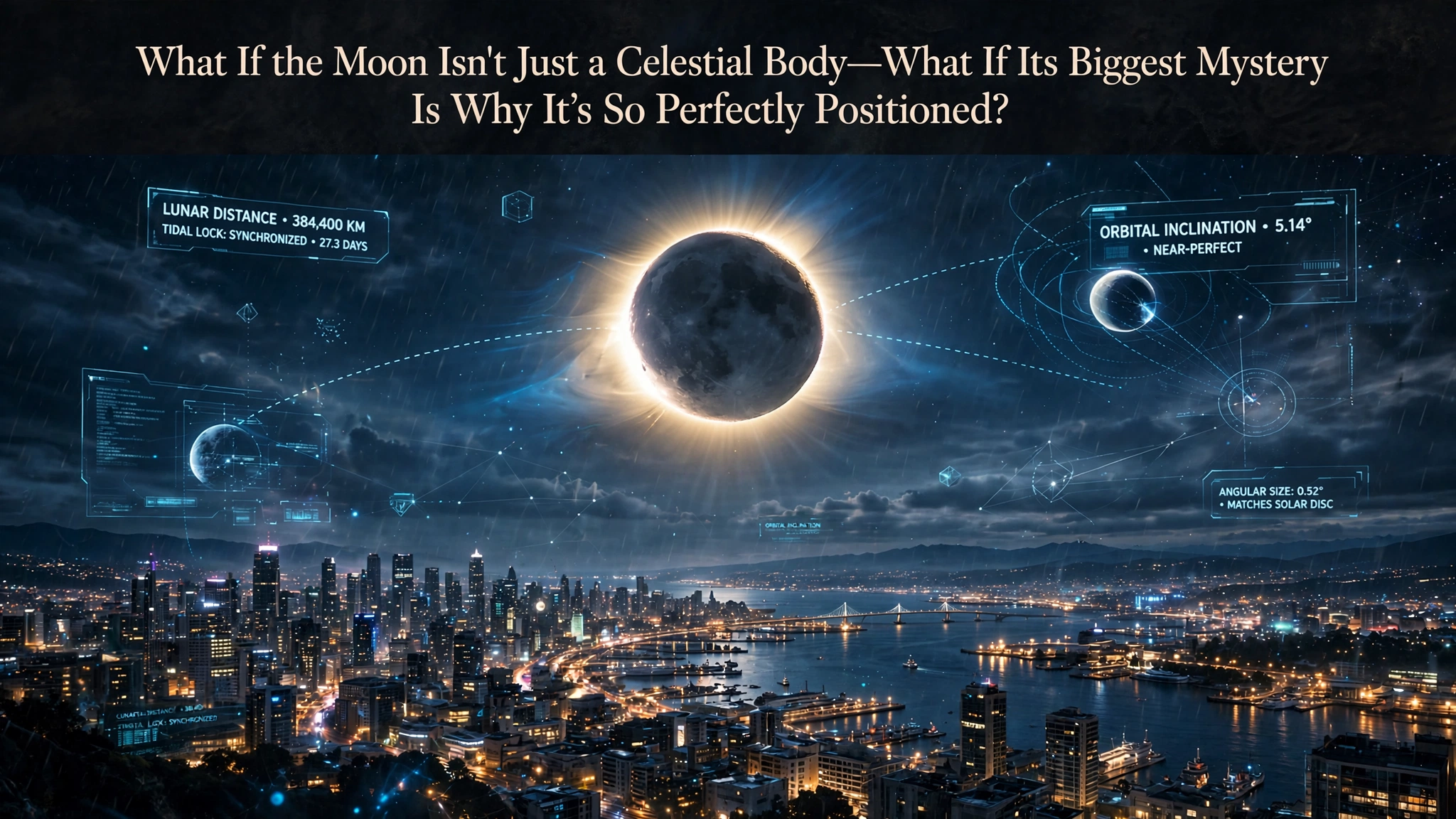
We've been looking at the Moon our entire lives, but how much do we actually question about it? An object in space that influences Earth's tides, creates solar eclipses, stabilizes our planet's axial tilt, and has inspired thousands of years of mythology. What if the biggest mystery isn't what the Moon is made of, but how much of its behavior we still take for granted?
Let's talk about the Moon.
That giant object hanging in the sky that everybody recognizes but rarely thinks about beyond whether it's full, whether it looks unusually large, or whether somebody is trying to take a blurry picture of it with their phone.
We've been taught that the Moon is Earth's natural satellite, approximately 4.5 billion years old, formed after a massive collision involving the early Earth and another planetary body. That's the leading scientific explanation, supported by lunar samples and other evidence.
But there are some genuinely fascinating details about the Moon that make people ask questions.
And naturally, where there are unanswered questions, conspiracy theories aren't far behind.
Why does the Moon appear almost perfectly sized to cover the Sun?
This is probably one of the most fascinating coincidences in astronomy.
The Sun is approximately 400 times wider than the Moon, but it's also approximately 400 times farther away from Earth. As a result, both objects appear nearly the same size in our sky.
That's why we can experience a total solar eclipse when the Moon passes directly between Earth and the Sun.
But here's the detail people sometimes overlook: this alignment isn't permanent. The Moon is gradually moving away from Earth, currently at roughly 3.8 centimeters per year. In the distant future, total solar eclipses as we know them will no longer be possible.
So no, the eclipse alignment isn't proof that somebody engineered the Moon. But it's an extraordinary coincidence that deserves appreciation.
Then there's the mystery of the Moon's interior.
For decades, conspiracy discussions have repeated the idea that the Moon is hollow or that it might contain something artificial.
One reason this theory became popular was the Apollo missions. Instruments left on the lunar surface detected seismic vibrations, and some impacts produced prolonged ringing signals.
That became the foundation for the popular phrase that the Moon supposedly rang like a bell.
But there's a scientific explanation worth understanding. The Moon is extremely dry compared with Earth, and its interior is structurally different. Its seismic waves can travel differently and remain detectable longer than comparable vibrations on Earth.
Scientific measurements support a differentiated interior with a crust, mantle, and core—not an established hollow structure.
Still, the fact that we can measure seismic activity on another world is fascinating enough without having to turn it into an alien construction project.
Why does the Moon always show us the same face?
This is another detail that sounds suspicious until you understand tidal locking.
The Moon rotates on its axis, but it takes approximately the same amount of time to rotate once as it takes to orbit Earth. That's why the same hemisphere generally faces us.
It isn't standing still. It isn't hiding its backside through some mysterious mechanism. It's rotating in synchronization with its orbit.
And the far side isn't permanently dark, either. It receives sunlight just like the near side.
But imagine how different human history might have been if we had never developed spacecraft capable of photographing that far side. For thousands of years, people could only speculate about what was there.
Ancient civilizations treated the Moon like something more than a rock in space.
Across different cultures, the Moon was connected to calendars, agriculture, mythology, religion, and the measurement of time.
Ancient civilizations tracked its phases and movements with impressive precision. Some built monuments and structures aligned with celestial events.
That doesn't establish that ancient people possessed secret alien technology or that extraterrestrials taught them astronomy. But it does remind us that humanity has been studying the sky for a very long time.
And sometimes the real story of ancient knowledge is more impressive than the conspiracy theory surrounding it.
But what if the Moon is hiding something we haven't discovered yet?
Let's separate speculation from evidence for a moment.
There are legitimate scientific questions about lunar water, the composition of its deep interior, its magnetic history, and the exact details of its formation. Future missions could reveal information that changes parts of our understanding.
Then there are the more extreme theories: that the Moon is artificial, that it was placed in orbit by an advanced civilization, or that it serves as some kind of extraterrestrial observation station.
Those ideas make for entertaining conversations, but there is currently no credible scientific evidence establishing them as facts.
And that's the distinction I find interesting. Questioning what we know is healthy. Deciding that every unexplained detail proves a particular conspiracy is where curiosity turns into assumption.
Maybe the real conspiracy isn't that the Moon is artificial. Maybe it's how easily we stop being curious once somebody gives us an explanation.
We don't have to believe every theory to appreciate a mystery. We don't have to invent an alien civilization to recognize that space is full of things humanity still doesn't understand.
We've walked on the Moon, brought samples back to Earth, placed instruments on its surface, and photographed places that human eyes had never seen before.
And somehow, that hasn't made the Moon any less fascinating.
So the next time you look up, consider this: you're looking at another world, orbiting the planet you call home, influencing the oceans beneath your feet, and preserving billions of years of solar system history.
We've spent centuries staring at the Moon. Maybe it's time we started asking better questions about it.










Comments
No comments yet, be the first submit yours below.