What If Your Personality Is Just a Collection of Survival Mechanisms You Forgot to Turn Off?

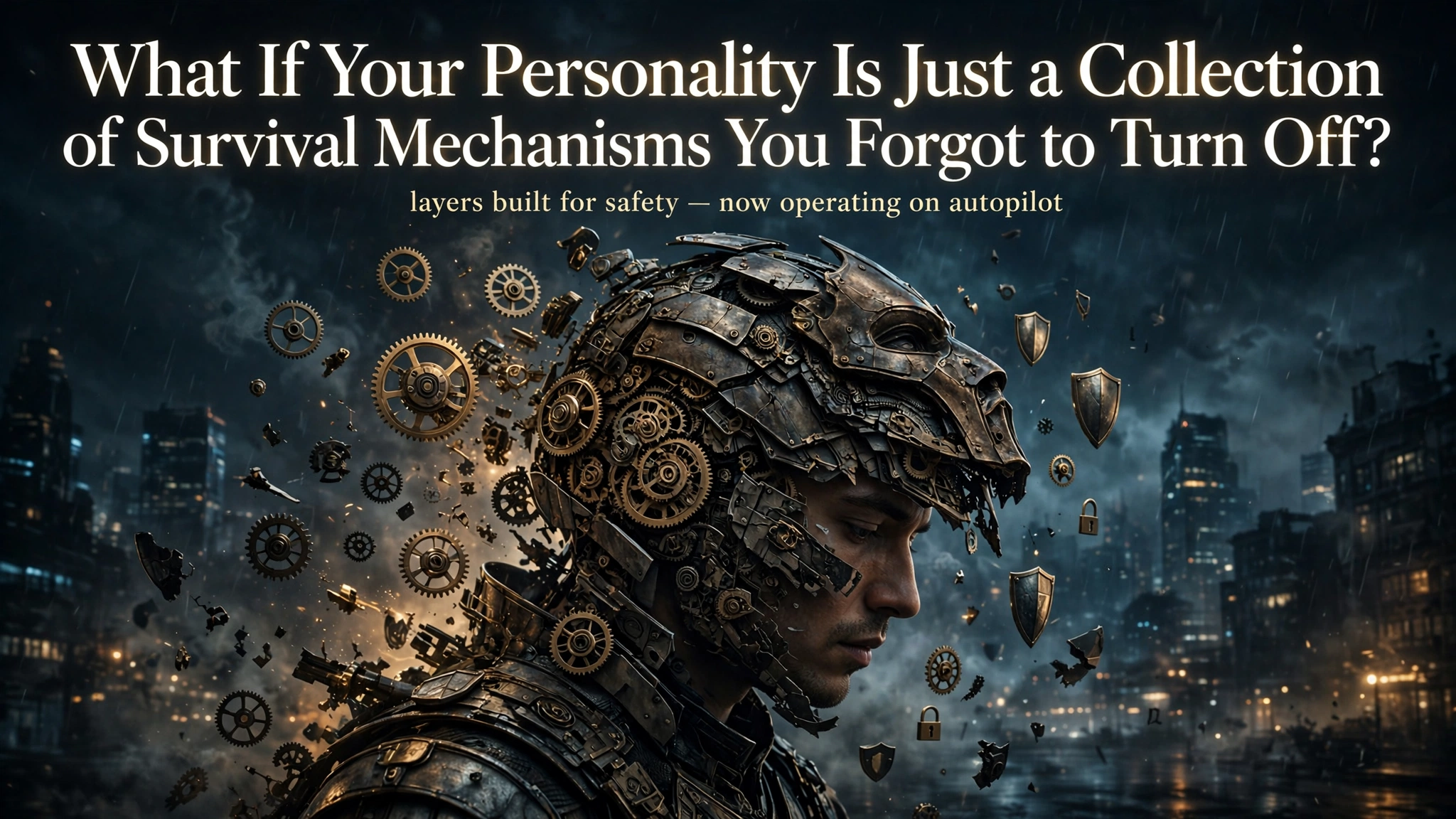
What if the person you call your personality is actually a collection of habits you developed just to survive situations you never wanted to be in? Maybe you're not naturally quiet. Maybe you learned that speaking up wasn't safe. Maybe you're not emotionally unavailable. Maybe you learned that being vulnerable came with a price. And maybe some of the things you call your personality are just old survival strategies wearing your name tag.
Think about how many times somebody has described themselves with a permanent label.
"I'm just an introvert." "I'm not affectionate." "I don't trust anybody." "I'm independent." "I don't need help." "I don't get attached." "I keep my circle small."
We say these things as if they were written into our DNA. But what if some of those characteristics developed because of what we experienced rather than who we naturally are?
What if the person you became was partly shaped by the environments you had to navigate?
YOU MIGHT NOT BE COLD. YOU MIGHT HAVE LEARNED TO PROTECT YOURSELF.
Some people struggle to express affection because they grew up in environments where affection was inconsistent. Others avoid emotional conversations because every disagreement used to become an argument. Some people refuse to ask for help because the last time they depended on somebody, they were disappointed.
Eventually, these responses can become familiar.
You stop explaining yourself. You stop asking questions. You stop expecting people to show up. You become the person who handles everything alone.
And then somebody meets you years later and calls you independent.
They don't necessarily know that your independence might have started as a response to having nobody reliable to depend on.
YOUR ENVIRONMENT CAN TEACH YOU HABITS YOU NEVER INTENDED TO KEEP.
Consider somebody who grew up around constant conflict. They might become extremely good at reading facial expressions, noticing changes in someone's voice, and recognizing when a room feels uncomfortable.
Other people might call that person observant or intuitive.
But sometimes what looks like extraordinary awareness is a learned habit of watching for trouble.
Someone who grew up around unpredictable anger might become obsessed with keeping everybody happy. Someone who experienced repeated disappointment might stop getting excited about anything. Someone who was constantly criticized might become a perfectionist because making mistakes feels more dangerous than it should.
These patterns aren't universal, and they don't mean every personality trait comes from trauma. But experiences can shape how people respond to the world.
THE DANGER OF TURNING SURVIVAL INTO AN IDENTITY.
Here's where things get interesting.
A behavior that once helped you navigate a difficult situation might eventually become something that limits you.
Being guarded might have protected you from manipulation, but it could also prevent you from developing healthy relationships. Refusing help might have kept you from being disappointed, but it could also make ordinary responsibilities unnecessarily difficult.
Always expecting the worst might have helped you prepare for difficult situations, but it can also make it nearly impossible to enjoy something good without anticipating its ending.
And being the person who never needs anybody might sound powerful until you realize you've built a life where nobody knows how to help you, including the people who genuinely want to.
Sometimes the defense mechanism becomes the prison.
WHAT IF YOU'RE STILL RESPONDING TO PEOPLE WHO AREN'T EVEN IN YOUR LIFE ANYMORE?
Think about it.
You might be arguing with your current partner as if they're the person who hurt you five years ago. You might assume your employer has bad intentions because a previous employer exploited you. You might struggle to trust a friend because somebody you once considered family betrayed you.
The people in front of you today aren't automatically responsible for the experiences that shaped your expectations yesterday.
That doesn't mean ignoring red flags or giving everybody unlimited access to your life. It means learning to distinguish between an actual warning sign and an old fear being activated by a familiar situation.
Not everybody deserves your trust, but not everybody should have to spend their time proving they're innocent of somebody else's mistakes.
YOU'RE ALLOWED TO OUTGROW THE VERSION OF YOURSELF THAT GOT YOU THROUGH THE WORST PARTS OF YOUR LIFE.
Maybe you don't have to be the person who always says no. Maybe you can learn to accept help without feeling weak. Maybe you can express affection without assuming it will eventually be used against you. Maybe you can disagree with somebody without preparing for the relationship to end.
Changing doesn't mean the old version of you was wrong. That version may have been doing the best it could with what it knew at the time.
But survival and living aren't necessarily the same thing.
You can appreciate the person who helped you get through difficult circumstances without requiring that person to control every decision you make going forward.
THE QUESTION WORTH ASKING
How much of your personality is genuinely who you are, and how much is who you learned to become because of the people, situations, and environments surrounding you?
Are you naturally distant, or did you learn that closeness creates complications? Are you genuinely comfortable doing everything alone, or did you stop asking because people kept letting you down? Are you really somebody who doesn't care, or did you learn to act like you don't care because caring made you vulnerable?
These aren't questions with one universal answer. But they're worth examining.
Because sometimes personal growth isn't about becoming an entirely different person. It's about recognizing which parts of your behavior still serve you and which parts are simply leftovers from a chapter that ended years ago.
You don't have to spend the rest of your life being the person you had to become to survive the life you used to live. At some point, you deserve to find out who you are when you're no longer operating in survival mode.






Comments
No comments yet, be the first submit yours below.